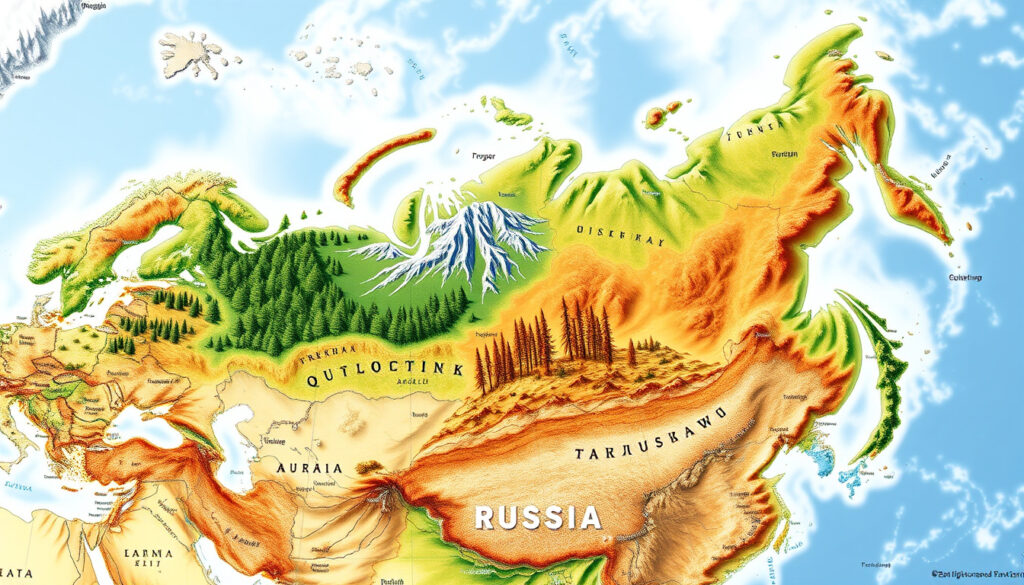
What Continent Is Russia In? Europe, Asia, or Both
Open a world map and Russia’s vastness is immediate: it spans Europe and Asia, making it a transcontinental country. The short answer: it’s in both.
Total area: 17.1 million square kilometers (6.6 million sq mi) ·
Time zones spanned: 11 ·
Population (approx.): 144 million ·
European portion of land: ~23% ·
Asian portion of land: ~77% ·
Population living in European part: ~75%
Quick snapshot
- Russia spans both Europe and Asia (MapsofWorld geography resource)
- The Ural Mountains form the conventional boundary (Wikipedia geography reference)
- Moscow sits in European Russia (Encyclopedia Britannica country profile)
- Russia is the largest country by land area (CIA World Factbook official data)
- Whether cultural and political alignment follows the geographic boundary (MapsofWorld geography resource)
- The exact definition of “continent” varies (some consider Europe a subcontinent of Eurasia) (Worldometers continent classification)
- Historical boundaries have shifted over centuries (Britannica Ural Mountains history)
- Ural Mountains formed 250–300 million years ago in continental collisions (NASA Earth Observatory geological data)
- Conventional Europe–Asia boundary established through persistent geographic usage (NASA Earth Observatory geological data)
- Cartographic and cultural definitions continue to evolve as geopolitical identities shift (Worldometers continent classification)
Here are the key geographic and demographic facts about Russia’s transcontinental status.
| Attribute | Value |
|---|---|
| Official Name | Russian Federation |
| Capital | Moscow |
| Largest City | Moscow |
| Total Area | 17,098,246 km² (6,601,670 sq mi) |
| Population (2024 est.) | 144,236,933 |
| Time Zones | 11 |
| Transcontinental Status | Yes – Europe and Asia |
| Conventional Boundary | Ural Mountains |
| Government | Federal semi-presidential republic |
About 75% of Russia’s population lives on just 23% of its territory — the European side west of the Urals. The Asian part, Siberia and the Far East, holds 77% of the land but only a quarter of the people.
Is Russia in Asia or Europe?
The conventional boundary: Ural Mountains
- The Ural Mountains run approximately 2,500 kilometers north–south from the Arctic Ocean region to near Kazakhstan (NASA Earth Observatory).
- NASA describes these mountains as a natural divide between Europe and Asia, formed between 250 and 300 million years ago by continental collisions. (geological data)
- The Urals are among the world’s oldest extant mountain ranges (Wikipedia geography reference).
A roadside monument near Yekaterinburg marks an official boundary between European and Asiatic Russia in the southern Urals (David H. Mould travel geography).
The Ural boundary is a convention, not a geological law. There is no tectonic plate boundary under the mountains — the line exists because cartographers and historians agreed it does.
Russia’s dual continental footprint
- Approximately 23% of Russia’s land area lies in Europe, 77% in Asia (MapsofWorld geographic analysis).
- About 75% of Russia’s population lives in the European part (MapsofWorld demographic data).
- The country spans from Kaliningrad on the Baltic Sea (Europe) to the Kamchatka Peninsula on the Pacific Ocean (Asia).
The implication: Russia’s geographic center of gravity is in Asia, but its demographic, political, and historical center is in Europe. This split defines much of the country’s cultural identity.
Is Russia the only country in two continents?
Other transcontinental countries
- Russia is not the only transcontinental country; others include Turkey (Europe and Asia), Kazakhstan (Europe and Asia), and Egypt (Africa and Asia) (WorldAtlas transcontinental list).
- Turkey straddles the Bosporus strait, Kazakhstan lies across the Ural River, and Egypt spans the Sinai Peninsula.
Why Russia is unique
- Russia is the largest transcontinental country by land area by a massive margin (CIA World Factbook area data).
- No other country controls territory across such a vast longitudinal span — Russia covers 11 time zones.
- Russia’s European portion alone (roughly 3.9 million km²) would still be the largest country in Europe by itself.
Bottom line: Russia is the most extreme example of a transcontinental country by land area. For anyone asking “what continent is Russia in”, the accurate answer is both Europe and Asia — but the European side dominates population and power.
What continent is Moscow in?
Moscow’s location within Europe
- Moscow is located in the European part of Russia, west of the Ural Mountains (Britannica Russia geography).
- The city lies on the Eastern European Plain, approximately 1,300 km west of the Urals.
- Moscow’s coordinates (55.7558° N, 37.6173° E) place it firmly in Eastern Europe by any conventional continent definition.
Geographic coordinates and region
- The Russian capital sits between the Volga and Oka rivers, in the heart of European Russia.
- European Russia extends from the Baltic Sea to the Ural Mountains and from the Arctic Ocean to the Black Sea.
The pattern: Moscow’s continental identity is never debated. While Russia as a whole is transcontinental, its capital is unequivocally European — a fact that shapes policy, culture, and international perception.
Where is Russia located on the world map?
Russia’s position in the Northern Hemisphere
- Russia extends across northern Eurasia, from the Baltic Sea in the west to the Pacific Ocean in the east (Britannica geography overview).
- The country lies entirely in the Northern Hemisphere, spanning latitudes from about 41° N to 82° N.
- Russia covers more than 11 time zones, more than any other country (CIA World Factbook time zone data).
Bordering countries and oceans
- Russia borders 14 countries: Norway, Finland, Estonia, Latvia, Lithuania, Poland, Belarus, Ukraine, Georgia, Azerbaijan, Kazakhstan, China, Mongolia, and North Korea (Wikipedia Russia country data).
- It touches two oceans: the Arctic Ocean (north) and the Pacific Ocean (east).
- Key seas include the Baltic, Black, Caspian, Barents, and Bering seas.
The catch: Russia’s northern location means most of its coastline is frozen for much of the year, limiting year-round maritime access.
Is Russia a country?
Official status of the Russian Federation
- Russia is a sovereign country, officially the Russian Federation (Britannica official profile).
- It is the largest country in the world by area, covering 17,098,246 km² (CIA World Factbook).
- Russia is a federal semi-presidential republic, divided into 83 federal subjects.
Political and geographic definition
- The Russian Federation formed after the dissolution of the Soviet Union in 1991.
- Its transcontinental status is recognized by the United Nations and most international organizations.
- Russia holds a permanent seat on the UN Security Council and participates in both European and Asian regional bodies.
Russia’s transcontinental identity creates practical consequences: it participates in the Council of Europe and the OSCE while also being a member of the Shanghai Cooperation Organisation and forging ties across Asia.
“The Ural Mountains have traditionally been considered the natural boundary between Europe and Asia because of their distinct geographic divide.”
“Russia, country that stretches over a vast expanse of eastern Europe and northern Asia. Once the preeminent republic of the Union of Soviet Socialist Republics, Russia became an independent country after the dissolution of the Soviet Union in December 1991.”
Encyclopedia Britannica (encyclopedic reference)
“Russia is the largest country in the world, covering 17,098,246 square kilometers. Its transcontinental span from Eastern Europe to the Pacific Ocean makes it unique among nations.”
CIA World Factbook (official U.S. government data)
| Attribute | European part | Asian part |
|---|---|---|
| Land area (% of total) | ~23% | ~77% |
| Population (% of total) | ~75% | ~25% |
| Major cities | Moscow, St. Petersburg, Nizhny Novgorod | Novosibirsk, Vladivostok, Yekaterinburg (on boundary) |
The boundary between Europe and Asia, defined by the Ural Mountains, underscores the transcontinental nature of Russia and its unique position across two continents.
Frequently asked questions
What percentage of Russia is in Asia?
Approximately 77% of Russia’s land area lies in Asia, east of the Ural Mountains. The remaining 23% is in Europe (MapsofWorld geographic analysis).
How much of Russia’s population lives in Europe?
About 75% of Russia’s population lives in the European part of the country, despite it being the smaller land portion (MapsofWorld demographic data).
Which other countries are transcontinental?
Other transcontinental countries include Turkey (Europe and Asia), Kazakhstan (Europe and Asia), Egypt (Africa and Asia), and there are several others depending on how continental boundaries are drawn (WorldAtlas transcontinental list).
Why are the Ural Mountains considered the boundary?
Geographers and cartographers historically established the Ural Mountains as the conventional dividing line between Europe and Asia. NASA describes them as a natural divide formed by ancient continental collisions (NASA Earth Observatory).
Is Siberia part of Asia?
Yes, Siberia is the vast Asian part of Russia, lying east of the Ural Mountains. It covers most of Russia’s territory but has a relatively sparse population (Britannica Russia geography).
Does Russia have any territory in North America?
Historically, Russia had territory in North America (Alaska was Russian until 1867). Today, Russia has no territory in North America, though it comes within about 80 km of Alaska at the Bering Strait (Radio Free Europe / Radio Liberty historical context).
Do Russians consider themselves European or Asian?
Opinions vary widely. Many Russians, especially those in the European part of the country, identify more with European culture. However, Russia’s unique transcontinental identity means many embrace a distinct Eurasian identity that combines both influences.
More related posts
 HMRC Bank Account Warning – Spot Scams and Stay Safe
 Danny Jones and Maura Higgins: Kiss Scandal Explained
 CSK vs MI Timeline: IPL History, Head-to-Head & Key Matches
 Creutzfeldt-Jakob Disease – Symptoms, Causes, Transmission and Care
 Sarah Beeny: Biography, Net Worth, Cancer & New Life
 Tote Bags for Women – Best Styles Sizes Buying Guide
 Picture Frames in Ireland: Trends, Costs & Best Places (2026)
 Cast of Ghostbusters: Frozen Empire — Who’s In, Who’s Out
