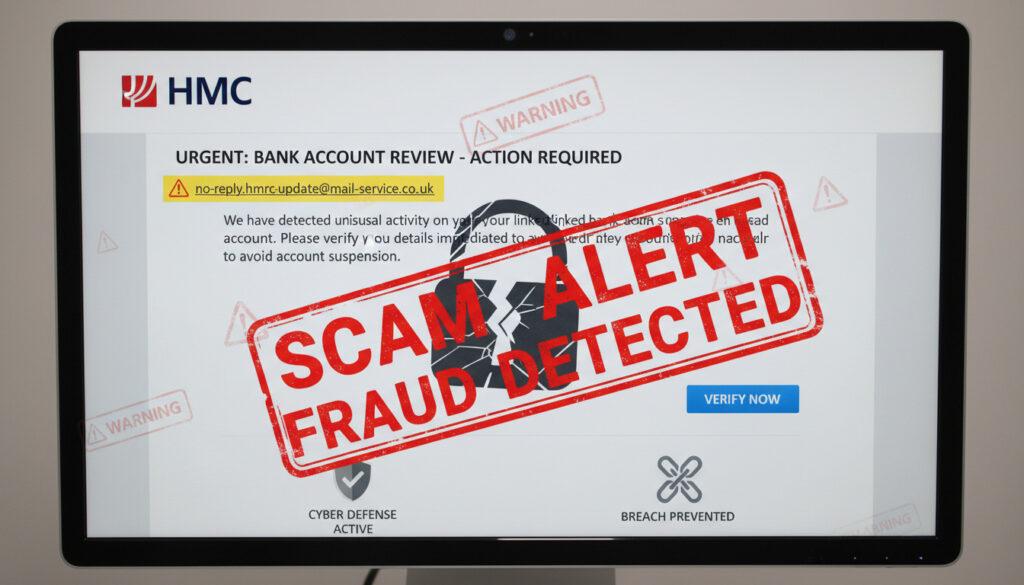
HMRC Bank Account Warning – Spot Scams and Stay Safe
Fraudsters are impersonating HM Revenue and Customs to steal bank account details through convincing phone calls, emails, and text messages. These scams often involve urgent warnings about frozen accounts, unpaid taxes, or promised refunds, creating immediate pressure that prompts victims to share sensitive financial information.
Recent data reveals the scale of this criminal activity. Over 135,500 HMRC-related scams were reported in the ten months leading to July 2025, with authorities working to dismantle thousands of fraudulent websites and phone numbers. Understanding how these scams operate and verifying official communication channels has become essential for taxpayers.
Similar to how scammers exploit delivery notifications, as detailed in our Royal Mail Pick Up Guide, criminals impersonating HMRC rely on the victim’s expectation of official financial correspondence.
What Is the HMRC Bank Account Warning?
- HMRC never demands immediate payment or threatens arrest via telephone
- Over 135,500 scam reports were filed in the ten months to July 2025
- Fraudsters specifically request bank statements, account details, and identification documents
- Caller ID spoofing makes fraudulent calls appear to originate from genuine HMRC numbers
- Tax refund promises serve as the primary lure to extract credit card and banking information
- Authorities shut down nearly 25,000 fake websites and phone lines in the past ten months
- Self Assessment taxpayers filed 4,800 scam reports between February and July 2025
| Metric | Data Point | Source |
|---|---|---|
| Total Scam Reports (10 months) | 135,500+ | GOV.UK |
| Fake Tax Refund Claims | 29,000 | GOV.UK |
| Self Assessment Scams (Feb-July 2025) | 4,800 | GOV.UK |
| Suspicious Contacts (12 months to July 2025) | 170,000 | Riddingtons |
| Fake Sites/Numbers Closed | ~25,000 | GOV.UK |
| Fake Refund Reports (subset) | 45,000 | Riddingtons |
| Primary Threat Vector | Arrest/Imprisonment threats | Riddingtons |
| Sensitive Documents Targeted | Bank statements, VAT returns, driving licences | ICAEW |
Can HMRC Freeze Your Bank Account and Is It Legitimate?
HMRC possesses legal authority to investigate tax fraud and can ultimately freeze bank accounts through court orders, but the department follows strict protocols. Crucially, HMRC does not initiate contact via telephone to announce such actions or demand immediate payment to prevent account freezing.
Does HMRC ever ask for bank details over the phone?
No. HMRC will never request personal or financial information through text messages, emails, or unsolicited phone calls. The department issues all formal correspondence regarding tax debts or investigations through postal mail.
Is HMRC contacting about bank refunds legitimate?
Communications claiming to be from HMRC regarding tax refunds sent via email, text, or phone are fraudulent. HMRC does not use these channels to inform customers about refunds or to request banking details to process payments.
HMRC will never leave voicemails threatening legal action, arrest, or imprisonment. Any message creating immediate fear of criminal prosecution is a scam designed to bypass rational thinking.
How to Spot a Fake HMRC Bank Account Scam
Urgency and Threat Tactics
Fraudsters manufacture false deadlines, claiming officers are en route to arrest you unless payment clears within hours. This pressure tactic prevents victims from verifying claims through official channels.
Requests for Sensitive Documentation
Scammers request photographs of driving licences, bank statements, VAT returns, and account passwords. Legitimate HMRC officials never solicit these materials via electronic communication.
Spoofed Communication Channels
Advanced spoofing technology allows criminals to mimic genuine HMRC telephone numbers. The display may show official-looking codes, but the caller is not affiliated with the department.
Always cross-reference contact details against the official GOV.UK website. Do not rely on caller ID, as numbers can be spoofed to appear authentic.
What to Do If You Get an HMRC Bank Account Warning
Immediate cessation of communication protects your financial security. Terminate phone calls without providing information and avoid clicking links in suspicious messages.
Reporting Procedures
Forward suspicious emails to phishing@hmrc.gov.uk and text fraudulent SMS messages to 60599. Report suspicious phone calls through the official GOV.UK reporting tool.
If You Experience Financial Loss
Contact your bank immediately to secure compromised accounts. File a report with Action Fraud by calling 0300 123 2040 or using their online reporting tool. Scottish residents should contact Police Scotland on 101.
Use strong, unique passwords for all financial accounts. This prevents scammers who obtain partial information from accessing other banking services.
How Have HMRC Bank Scams Evolved Over Time?
- 2018: Initial surge in threatening telephone calls claiming unpaid tax debts
- 2023: Significant spike in reported phishing attempts using fake refund notifications
- August 2024: Widespread distribution of fraudulent letters requesting sensitive tax documents (ICAEW)
- February 2025: 4,800 Self Assessment scams reported within a five-month period
- July 2025: Cumulative reports reach 135,500 scams over ten months, prompting HMRC to close 25,000 fake digital assets
What Is Certain and Uncertain About HMRC Bank Account Actions?
| Established Facts | Uncertain or Variable Information |
|---|---|
| HMRC initiates formal contact exclusively through postal mail | Specific spoofing technologies employed by individual criminal networks |
| HMRC never requests bank details via phone, text, or email | Exact financial losses per victim (only total reports are published) |
| Arrest threats via voicemail are exclusively fraudulent | Geographic concentration of specific scam variants within the UK |
| Reporting mechanisms: phishing@hmrc.gov.uk and 60599 | Success rates of HMRC’s website takedown operations |
Why Do Fraudsters Target Bank Accounts Using HMRC’s Name?
Fraudsters exploit the authority and complexity of the UK tax system. The Universal Credit Cost of Living Payment and other government financial interactions have heightened public awareness of official money transfers, making fake refund claims more plausible.
The timing of these scams often coincides with Self Assessment deadlines when taxpayers anticipate genuine contact. Criminals also exploit the fear of legal consequences, knowing that threats of arrest create immediate anxiety that overrides caution.
Scammers manipulate the fact that many taxpayers genuinely owe money or anticipate refunds, blurring the line between legitimate tax obligations and fraudulent demands.
What Do Authorities Say About Bank Account Scams?
“HMRC will never ask for personal or financial information via text message or email, or contact customers by email, text, or phone to inform them about a refund or ask them to claim one.”
— HMRC Official Guidance, 2025
“Take a moment to think before sharing money or information. Do not trust caller ID on phones, as numbers can be spoofed.”
— Institute of Chartered Accountants in England and Wales (ICAEW)
How Can You Stay Safe From HMRC Bank Account Scams?
Protect yourself by verifying all HMRC contact through official GOV.UK channels, never sharing bank details in response to unsolicited calls or messages, and reporting suspicious activity immediately. Remember that genuine tax communications arrive by post, while urgent threats demanding immediate payment are invariably fraudulent.
Frequently Asked Questions
What should I do if I already provided my bank details?
Contact your bank immediately to freeze the account and prevent unauthorized transactions. Report the incident to Action Fraud and monitor your statements for suspicious activity.
Can HMRC freeze my bank account without warning?
HMRC can pursue legal action to freeze accounts for serious tax fraud, but this requires court proceedings and extensive prior written correspondence. They do not freeze accounts based on telephone warnings.
Are any HMRC text messages legitimate?
HMRC does not send texts requesting personal information or announcing refunds. While they may send generic reminders, any message containing links or requesting data is fraudulent.
How does HMRC actually verify tax issues?
HMRC verifies issues through postal correspondence to your registered address. They may request documentation through your Personal Tax Account online, but never via unsolicited email attachments.
Where should I report a suspicious HMRC email?
Forward suspicious emails to phishing@hmrc.gov.uk and text messages to 60599. For phone scams, use the reporting tool on GOV.UK.
More related posts
 Rachel Shenton Movies and TV Shows – Full Filmography and Career Guide
 Tony Maudsley: Benidorm, Coronation Street, and Personal Life
 Maslow Hierarchy of Needs: 5 Levels and Anxiety
 Robin Williams Cause of Death: Full Story of His Final Days
 Where to Watch True Detective: UK & Ireland Guide
 In Print We Trust Review: Quality, Codes, and Founder
 Punjab Kings vs Delhi Capitals Timeline: IPL 2026 Records
 Jodie Turner-Smith: Bio, Movies, Divorce, Ethnicity & News
