Creutzfeldt-Jakob Disease – Symptoms, Causes, Transmission and Care
Creutzfeldt-Jakob disease represents one of the most challenging neurodegenerative conditions in modern medicine. This rapidly progressive disorder damages the brain at an alarming pace, ultimately proving fatal in every documented case. Understanding its symptoms, causes, and transmission patterns remains crucial for families, healthcare professionals, and researchers working to manage its devastating impact.
The condition belongs to a family of disorders known as prion diseases, which share a distinctive mechanism involving misfolded proteins. Though rare—with approximately one case occurring per million people annually—the disease’s severity and rapid progression demand careful attention. Medical teams worldwide continue investigating the precise mechanisms by which these misfolded proteins trigger such devastating neurological decline.
What Are the Symptoms of Creutzfeldt-Jakob Disease?
Early indications of Creutzfeldt-Jakob disease often emerge subtly, frequently mistaken for more common conditions. Initial symptoms typically include rapidly worsening dementia, noticeable personality changes, persistent confusion, and progressive memory loss. Patients commonly report sleep disturbances, symptoms resembling depression, and visual problems that may include difficulty with depth perception or recognizing objects.
Early Warning Signs
- Memory impairment affecting daily activities
- Unexplained personality shifts or emotional instability
- Growing confusion and disorientation
- Sleep disturbances including insomnia
- Visual disturbances and coordination difficulties
- Depression-like symptoms without clear trigger
Disease Progression
As the condition advances over weeks and months, neurological deterioration accelerates significantly. Patients develop myoclonus—characterized by sudden, involuntary jerking movements—alongside worsening ataxia that compromises coordination and balance. Many individuals experience strange sensations resembling numbness or tingling, progressive muscle weakness that may lead to immobility, and vision problems that can progress to blindness.
The terminal phases often involve akinetic mutism, where patients lose the ability to move or speak despite apparent consciousness. Complete coma typically follows, with most deaths occurring within twelve months of symptom onset. Approximately 15 percent of patients survive two years or longer, though this represents a small minority of cases.
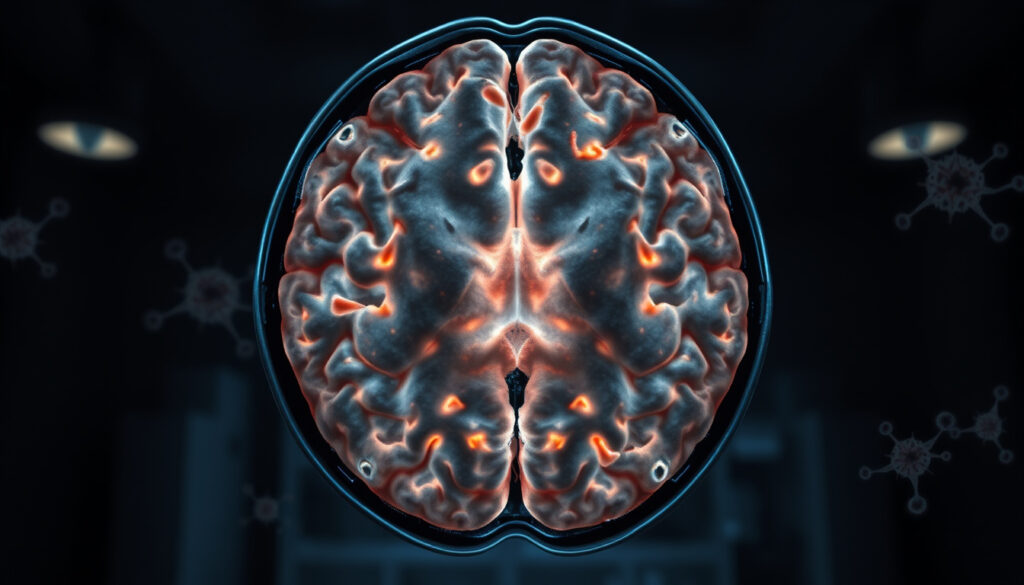
MRI imaging plays a vital role in diagnosis, revealing characteristic cortical ribboning—hyperintense signal changes in the cerebral cortex and basal ganglia on diffusion-weighted and FLAIR sequences. These findings, documented extensively in radiopaedia references, help distinguish Creutzfeldt-Jakob disease from other forms of dementia.
What Causes Creutzfeldt-Jakob Disease?
The underlying cause of Creutzfeldt-Jakob disease lies in prions—misfolded proteins that somehow induce normal versions of the same protein to adopt their abnormal shape. Unlike viruses or bacteria, prions contain no genetic material, yet they replicate by fundamentally altering the structure of healthy prion proteins, triggering a cascade of neuronal damage that produces the characteristic spongiform appearance of affected brain tissue.
Types and Their Origins
Sporadic Creutzfeldt-Jakob disease accounts for roughly 85 percent of all cases, occurring without any identifiable trigger or family pattern. Medical researchers have not determined why certain individuals develop these misfolded proteins spontaneously. Age represents the primary known risk factor, with most cases appearing in people between 50 and 70 years old.
Familial or genetic Creutzfeldt-Jakob disease comprises approximately 5 to 15 percent of diagnoses, stemming from mutations in the PRNP gene that encodes the prion protein. This form follows autosomal dominant inheritance, meaning a single copy of the altered gene from either parent transmits the risk. Children of affected individuals face roughly a 50 percent chance of inheriting the mutation. Several specific subtypes exist within this category, including Gerstmann-Sträussler-Scheinker syndrome and fatal familial insomnia, each presenting with slightly different clinical features.
Families affected by hereditary forms may benefit from genetic counseling services. Testing can identify whether individuals carry PRNP mutations before symptoms develop, though this decision involves complex personal and ethical considerations that warrant thorough discussion with healthcare providers.
How Is Creutzfeldt-Jakob Disease Transmitted?
Creutzfeldt-Jakob disease does not spread through casual contact, making it fundamentally different from infectious conditions that transmit via airborne particles or physical proximity. Patients cannot pass the disease to family members through hugging, sharing food, or sexual contact. Healthcare workers face no increased occupational risk, contrary to historical concerns about exposure during medical procedures.
Medical and Procedural Transmission
Iatrogenic transmission—occurring through medical interventions—remains exceptionally rare in contemporary practice. Historical cases arose primarily from contaminated human growth hormone preparations derived from pituitary glands, distributed between 1958 and 1985 before manufacturing processes changed. Additional transmission events involved corneal transplants from infected donors, dura mater grafts, and neurosurgical equipment that had contacted infected brain tissue.
Transmission requires direct exposure to infected nervous system tissue or specific biological materials, with incubation periods potentially extending across decades before symptoms emerge. Comprehensive guidelines from the Centers for Disease Control and Prevention outline infection control protocols for healthcare settings handling potentially contaminated materials.
Variant CJD and BSE Connection
Variant Creutzfeldt-Jakob disease emerged in the 1990s as a distinct form linked to consumption of products contaminated with bovine spongiform encephalopathy—commonly known as mad cow disease. This variant typically affects younger individuals and presents with psychiatric symptoms preceding neurological decline. Research documented by the Alzheimer’s Association confirms that blood transfusion transmission, while exceedingly rare, has occurred in approximately five documented UK cases.
The general population faces no meaningful risk from food consumption in countries with established BSE surveillance programs. Blood donation restrictions exist in some regions for individuals with potential exposure histories, though these policies vary by jurisdiction and evolve as scientific understanding advances.
What Is the Treatment for Creutzfeldt-Jakob Disease?
Currently, no cure exists for Creutzfeldt-Jakob disease, and no treatment can slow or halt its progression. Prions demonstrate remarkable resistance to conventional therapeutic approaches, including antiviral medications, antibiotics, and anti-inflammatory steroids. Despite extensive research efforts spanning decades, scientists have not identified any disease-modifying intervention that changes the fundamental course of the condition.
Supportive Care Approaches
Medical teams focus on managing symptoms and maximizing patient comfort throughout the illness trajectory. Myoclonus—among the most distressing symptoms—may respond partially to medications such as clonazepam or sodium valproate, though responses vary considerably among individuals. Comprehensive pain management, nutritional support, and prevention of secondary complications like infections represent essential components of care.
As cognitive and physical decline accelerates, most patients require increasingly intensive support with daily activities. Many families elect hospice or palliative care services as the condition advances, ensuring comfort becomes the primary focus during the final stages. According to the Cleveland Clinic, median survival ranges between four and six months following symptom onset, with the disease proving universally fatal.
A Timeline of Key Developments
Medical understanding of Creutzfeldt-Jakob disease evolved considerably throughout the twentieth century, with several pivotal moments shaping contemporary knowledge.
- 1920s: German neurologists Hans Gerhard Creutzfeldt and Alfons Maria Jakob independently described the condition that would bear their names, establishing the foundational clinical description.
- 1950s-1960s: Early research began distinguishing between sporadic and familial forms, setting the stage for genetic investigation.
- 1980s: Iatrogenic transmission cases linked to contaminated growth hormone preparations prompted manufacturing safety reforms.
- 1990s: Discovery of variant Creutzfeldt-Jakob disease and its connection to bovine spongiform encephalopathy triggered global food safety responses and intensive surveillance programs.
- 1997: Stanley Prusiner received the Nobel Prize for establishing prion theory, fundamentally reshaping understanding of neurodegenerative disease mechanisms.
- Present: Ongoing research continues exploring therapeutic targets, though effective treatments remain elusive.
What Is Certain and What Remains Unclear?
Medical science has established several core facts about Creutzfeldt-Jakob disease while acknowledging significant gaps in understanding that persist today.
| Established Knowledge | Remaining Uncertainties |
|---|---|
| Prion misfolding causes neuronal death and brain damage | Exact trigger mechanism for sporadic disease onset |
| Four distinct forms exist with different etiologies | Complete range of tissue compartments containing infectivity |
| MRI cortical ribboning indicates probable diagnosis | Long-term vCJD incidence projections |
| All forms progress rapidly and prove fatal | Why some patients survive significantly longer than median |
| No casual transmission occurs between individuals | Potential environmental or dietary cofactors |
| Genetic testing identifies familial risk | Modifiers affecting age of onset in hereditary cases |
The Broader Context of Prion Disease
Creutzfeldt-Jakob disease exists within a spectrum of related conditions collectively termed transmissible spongiform encephalopathies. These disorders share the fundamental mechanism of prion protein misfolding while presenting with different clinical features, affected species, and transmission pathways. Understanding this broader category helps contextualize why Creutzfeldt-Jakob disease presents such distinctive challenges.
The discovery that proteins alone—without any genetic material—could encode and transmit disease information represented a paradigm shift in biology. This recognition fundamentally altered approaches to neurodegenerative disease research, opening new avenues for investigating conditions like Alzheimer’s and Parkinson’s that share some mechanistic similarities with prion disorders. Resources from the National Institute of Neurological Disorders and Stroke provide additional context for understanding these related conditions.
Public health systems worldwide maintain surveillance programs monitoring prion disease patterns, reflecting the significant impact that variant Creutzfeldt-Jakob disease had on food safety policy and medical practice. These monitoring efforts continue providing essential data for understanding disease trends and responding to potential future threats.
“Creutzfeldt-Jakob disease represents a devastating condition that profoundly affects not only patients but their entire families. While research continues, current focus emphasizes accurate diagnosis, supportive care, and family support throughout the illness course.”
Summary
Creutzfeldt-Jakob disease constitutes a rare but devastating neurodegenerative condition caused by prion protein misfolding. Four distinct forms exist—sporadic, familial, iatrogenic, and variant—with different origins but similar devastating progression. Early symptoms include rapidly worsening dementia, personality changes, and coordination difficulties, progressing to myoclonus, immobility, and coma typically within twelve months.
Diagnosis relies on clinical assessment supplemented by MRI findings showing characteristic cortical ribboning, EEG patterns, and cerebrospinal fluid markers. No cure exists, with treatment focused entirely on symptom management and patient comfort. Transmission does not occur through casual contact, though variant forms connect to dietary exposure to contaminated beef products.
Medical research continues investigating the precise mechanisms underlying prion propagation and exploring potential therapeutic interventions. For individuals concerned about symptoms or family history, consultation with neurological specialists provides appropriate evaluation and support. Understanding the distinction between Creutzfeldt-Jakob disease and other neurological conditions—such as recognizing how symptoms differ from other cardiac or neurological presentations—remains valuable for informed health decisions.
Frequently Asked Questions
How do you pronounce Creutzfeldt-Jakob disease?
The standard pronunciation renders as “Kroyts-felt Yah-kop,” reflecting the German origin of both eponyms. American English adaptations sometimes vary slightly in emphasis, though the phonetic spelling remains consistent across medical literature.
What MRI findings indicate Creutzfeldt-Jakob disease?
Characteristic imaging findings include cortical ribboning visible on diffusion-weighted and FLAIR sequences, showing hyperintense signal in the cerebral cortex and basal ganglia structures including the putamen and caudate nucleus. These patterns help distinguish Creutzfeldt-Jakob disease from other dementias.
Can Creutzfeldt-Jakob disease be inherited?
Approximately 5 to 15 percent of cases involve PRNP gene mutations following autosomal dominant inheritance. Individuals with family histories should consider genetic counseling to understand personal risk factors and testing options.
Is Creutzfeldt-Jakob disease related to mad cow disease?
Variant Creutzfeldt-Jakob disease represents a distinct form linked to bovine spongiform encephalopathy exposure through contaminated beef products. The classic sporadic, familial, and iatrogenic forms do not share this dietary origin.
How quickly does Creutzfeldt-Jakob disease progress?
Most patients experience rapid decline, with median survival of four to six months from symptom onset. Approximately 15 percent survive beyond two years, though extended survival remains uncommon and does not alter the ultimately fatal outcome.
What is the difference between CJD and other dementias?
Creutzfeldt-Jakob disease differs from conditions like Alzheimer’s through its exceptionally rapid progression, younger average onset for variant forms, distinctive myoclonus patterns, and characteristic MRI findings. Accurate diagnosis requires neurological evaluation including imaging and laboratory studies.
More related posts
 Evans Halshaw Used Cars – Inventory, Warranties and Dealers
 Hot Wheels Stunt Show: 2026 Dates, Tickets & UK Tour
 Cast of Ghostbusters: Frozen Empire — Who’s In, Who’s Out
 Pinkie Pie: Neurodivergent Symbolism & Personality Type
 Megan Love Island 2025 – Age, Job, Coupling and Full Profile
 Best Arepa de Choclo Near Me: Guide to Sweet Corn Arepas
 Brigitte Macron as a child: early life, family and rare photos
 Jake Paul Broken Jaw: Joshua Fight Injury, Surgery & Recovery
