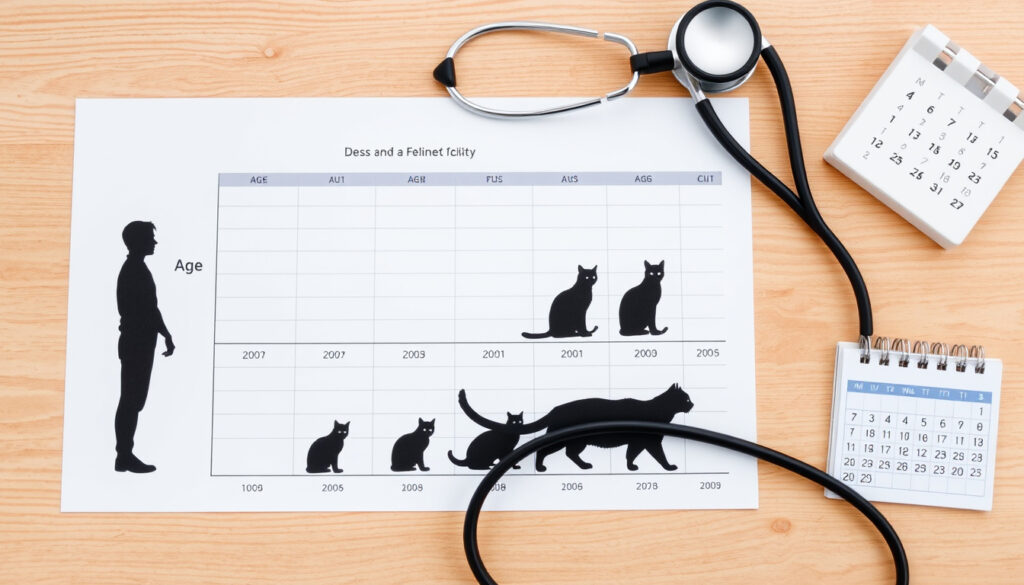
Cat Age in Human Years: Conversion Chart & Vet Guide
If you’ve ever tried to figure out your cat’s age in human years, you’ve probably heard the rule of thumb that one cat year equals seven human years. Turns out, that’s one of the biggest myths in pet care — and veterinary science has a much more accurate formula.
First year of a cat’s life equals human years: 15 ·
Second year adds human years: 9 ·
Cat years to 2 human years total: 24 ·
Each additional cat year after age 2 equals human years: 4 ·
A 15-year-old cat in human years: 76 ·
A 20-year-old cat in human years: 96
Quick snapshot
- First year = 15 human years (PetMD (veterinary medical resource))
- Second year = 24 human years (Purina (pet nutrition and care resource))
- Each year after 2 = 4 human years (AAHA (veterinary practice organization))
- Exact frequency of cats living to 20 years
- Individual variation in aging rate beyond the standard formula
- 0–1 year: Kitten = 15 human years (PetMD (veterinary medical resource))
- 2 years: Full social maturity = 24 human years (AAHA (veterinary practice organization))
- 3–6 years: Prime adult; annual vet checks recommended (PetMD (veterinary medical resource))
- 7+ years: Senior stage; twice-yearly visits advised (American Kennel Club (breed registry))
- Use the AVMA formula to monitor your cat’s life stage
- Watch for silent health threats like kidney disease
- Adjust diet and vet visits as your cat enters senior years
Sixteen conversion values, one pattern: cats age fastest in their first two years, then slow to a steady 4 human years per cat year.
| Cat age (years) | Human age equivalent |
|---|---|
| 1 | 15 |
| 2 | 24 |
| 3 | 28 |
| 5 | 36 |
| 7 | 44 |
| 8 | 48 |
| 9 | 52 |
| 10 | 56 |
| 15 | 76 |
| 18 | 88 |
| 20 | 96 |
Sources: Purina (pet nutrition and care resource), AAHA (veterinary practice organization), PetMD (veterinary medical resource)
How old is a 15 year old cat?
Cat years to human years conversion
A 15‑year‑old cat is approximately 76 human years old according to the AVMA formula endorsed by both PetMD (veterinary medical resource) and Purina (pet nutrition and care resource). That puts her solidly in the super‑senior category — equivalent to a human in their mid‑70s.
- First year = 15 human years
- Second year adds 9 = 24 total
- Each year after age 2 adds 4
The implication: the old 7‑year rule would have put her at 105 human years — nearly three decades higher. A 15‑year‑old cat is old, but not that old.
15 cat years in human years: 76 human years
At 76 human years, a cat is past the average life expectancy for outdoor cats (2–5 years) and well into the range of a well‑cared‑for indoor cat (12–18 years, per PetMD (veterinary medical resource)). This age calls for twice‑yearly vet visits, careful weight monitoring, and screening for chronic diseases.
A 15‑year‑old cat is hitting a life stage where silent conditions like kidney disease become far more likely. Knowing her true human age helps you schedule preventive care, not just reactive treatment.
How rare is it for a cat to live 20 years?
Cat life expectancy statistics
It’s uncommon but not unheard of. Only about 5–10% of cats reach 20 years, according to veterinary estimates. Indoor cats consistently outlive outdoor cats: average 12–18 years vs. 2–5 years. A 20‑year‑old cat is roughly 96 human years — a remarkable age by any standard.
Factors that extend cat lifespan
- Indoor living (eliminates trauma, predators, and infectious diseases)
- Regular veterinary care and vaccinations
- High‑quality nutrition and weight management
- Early detection of chronic disease
The pattern: longevity is largely within an owner’s control. A 20‑year lifespan is rare, but it’s a realistic goal for a well‑managed indoor cat.
If your cat reaches 20, you’ve done many things right — but that doesn’t mean she’s out of danger. Annual bloodwork becomes essential to catch the silent killers that become more common after 15.
What is the silent killer of cats?
Chronic kidney disease as a silent killer
Chronic kidney disease (CKD) affects approximately 1 in 3 senior cats, yet early signs are easily missed. The Close Veterinary Clinic (veterinary practice) lists increased thirst, weight loss, and poor coat condition as red flags. Because cats hide illness instinctively, owners often don’t notice until the disease is advanced.
Symptoms of kidney disease in cats
- Excessive drinking and urination
- Loss of appetite, vomiting
- Lethargy and hiding
- Bad breath (uremic odor)
Hyperthyroidism and other silent conditions
Hyperthyroidism, diabetes, and dental disease are other common stealth problems in older cats. Regular blood and urine tests are the only reliable way to detect them early — annual checks become mandatory after age 7.
The catch: the very traits that make cats great pets — independence, stoicism — also let disease go unnoticed until it’s advanced.
Chronic kidney disease is often called the silent killer because cats don’t show symptoms until 75% of kidney function is already lost.
Close Veterinary Clinic (veterinary practice)
What fruit can cats not eat?
Toxic fruits for cats
Grapes and raisins are the most dangerous — they can cause acute kidney failure even in tiny amounts. Citrus fruits (oranges, lemons, limes) contain essential oils and citric acid that cause digestive upset and central nervous system depression. Other fruits to avoid include cherries (pits contain cyanide) and unripe tomatoes.
Safe fruit alternatives
- Small amounts of seedless watermelon (no rind)
- Blueberries (washed and halved)
- Banana slices (very small portions)
The trade‑off: fruits are not a natural part of a cat’s diet. Even safe fruits should be occasional treats, not meal replacements.
Grapes and raisins are toxic to cats and can cause kidney failure. Keep all fruit away from your cat unless you’ve checked with your vet.
PetMD (veterinary medical resource)
What do cats do right before they pass away?
End-of-life signs in cats
According to the PDSA (UK animal welfare charity), cats nearing the end of life often withdraw, hide, lose interest in food and water, and may breathe with an open mouth or shallow panting. They may also stop grooming and become disoriented.
When to consider euthanasia
Quality‑of‑life indicators include: no longer eating or drinking, inability to use the litter box, constant pain, and loss of interest in human interaction. A veterinarian can guide the decision, but many owners recognize the moment their cat is suffering more than living.
What this means: the most loving act is knowing when to let go. PDSA emphasizes that cats don’t feel fear of death — they feel pain, and our job is to relieve it.
Why should you not stare a cat in the eyes?
Cat eye language
Direct, unblinking eye contact is a threat signal in feline body language. Cats interpret a prolonged stare as a predator’s challenge, which can cause fear or defensive aggression. The PDSA (UK animal welfare charity) explains that a hard stare signals dominance and potential danger to a cat.
How to safely make eye contact
- Use soft, slow blinks to communicate trust
- Avoid staring directly; look and then look away
- Blink slowly and wait for your cat to blink back — it’s the feline equivalent of saying “I love you”
The pattern: cats communicate a lot through their eyes. Learning to read them reduces stress for both of you and strengthens your bond.
A slow blink from a cat is a sign of trust and affection. If you return the gesture, you are speaking the same language.
PDSA (UK animal welfare charity)
Confirmed facts
- First year = 15 human years (PetMD (veterinary medical resource))
- Second year = 24 human years (Purina (pet nutrition and care resource))
- Each subsequent year = 4 human years (AAHA (veterinary practice organization))
- Indoor cats average 12–18 years; outdoor cats 2–5 years
- Chronic kidney disease affects 1 in 3 senior cats
- Grapes and raisins are toxic to cats
What’s unclear
- Exact percentage of cats that live to 20 years
- Individual aging variation beyond the standard formula
- Whether breed significantly alters the conversion rate (current evidence says minimal)
For a quick and accurate conversion, you can use this cat age in human years calculator that follows the same veterinary guidelines.
Frequently asked questions
What is the 3-3-3 rule for cats?
The 3-3-3 rule refers to the adjustment period for a new cat in a home: 3 days to decompress, 3 weeks to start showing their personality, and 3 months to feel fully settled. It’s a rescue guideline, not a medical law.
How do I say I love you in cat language?
A slow blink is the feline equivalent of blowing a kiss. Look at your cat, blink slowly, and look away. If she blinks back, you’ve just exchanged love signals.
What is the 7-year myth for cat years?
The idea that 1 cat year = 7 human years is an oversimplification that doesn’t match how cats actually age. The AVMA formula (15‑24‑4) is the accepted veterinary standard.
What is the average lifespan of an indoor cat?
Indoor cats live 12–18 years on average. With excellent care, many reach 20 years or more.
At what age is a cat considered geriatric?
Cats enter the geriatric stage at about 11–14 years of age, according to AAHA guidelines. At that point, twice‑yearly vet check‑ups are strongly recommended.
What are the first signs of kidney disease in cats?
Increased thirst, more frequent urination, weight loss, and a dull coat are early signs. Many owners don’t notice until the disease is advanced, which is why annual blood tests are critical for cats over 7.
Can cats eat grapes or raisins?
No. Grapes and raisins are toxic and can cause acute kidney failure. Even small amounts are dangerous. Contact your vet immediately if your cat ingests them.
What is a cat age calculator and how does it work?
A cat age calculator applies the AVMA formula automatically: 15 human years for year 1, plus 9 for year 2, then 4 for each year after. Online calculators are convenient but should be from a reputable veterinary source.
For cat owners, the choice is clear: replace the lazy 7‑year myth with the AVMA formula and adjust your care routine accordingly. A 15‑year‑old cat is 76, not 105 — and that means she has more good years ahead if you watch for silent kidney disease, avoid toxic fruits, and learn her body language. The difference between myth and fact isn’t just a number — it’s years of quality time with your feline friend.
More related posts
 Best SIM Only Deals UK: Compare Top Cheap Plans & Save
 Mar ton Recovery Contact Number: Official Phone & Advice
 Picture Frames in Ireland: Trends, Costs & Best Places (2026)
 LaMelo Ball: Age, Height, Net Worth, Contract, and More
 Fat Amy: Pitch Perfect Character vs. F-35 Jet Nickname
 Best PS5 Games 2025: Critic Picks and Reddit Favorites
 In Print We Trust Review: Quality, Codes, and Founder
 How Many ISAs Can I Have – UK Rules and Limits 2024/25
