Clement Attlee: Biography, Achievements, and Legacy
Most people know the name Winston Churchill, but the quiet man who followed him as prime minister reshaped Britain in ways that still touch every citizen. Clement Attlee walked into 10 Downing Street with a landslide mandate and proceeded to build the National Health Service, nationalise vast swaths of industry, and lay the foundation of the modern welfare state. This is the story of the unassuming reformer who changed a nation.
Prime Minister of the United Kingdom: 1945–1951 · Leader of the Labour Party: 1935–1955 · Founded the National Health Service: 1948 · Election landslide majority: 146 seats (1945) · Nationalised industries: around 20% of economy · Age when became PM: 62
Quick snapshot
- Born 1883 in Putney, London (Encyclopaedia Britannica)
- Attended Haileybury College (Wikipedia)
- Studied law at University College, Oxford (Encyclopaedia Britannica)
- MP for Limehouse from 1922 (Wikipedia)
- Leader of Labour Party from 1935 (Encyclopaedia Britannica)
- Deputy Prime Minister in Churchill’s coalition (Wikipedia)
- Prime Minister 1945-1951 (Encyclopaedia Britannica)
- Created the National Health Service (Wikipedia)
- Nationalised coal, railways, steel, and electricity (Encyclopaedia Britannica)
- Established the welfare state (Encyclopaedia Britannica)
- Granted independence to India (Wikipedia)
- Married Violet Millar in 1922 (Wikipedia)
- Four children (Wikipedia)
- Known as modest and unassuming (Encyclopaedia Britannica)
The key facts about Clement Attlee, drawn from biographical records and official sources, present a clear picture of the man behind the reforms.
| Full Name | Clement Richard Attlee |
| Born | 3 January 1883, Putney, London (Encyclopaedia Britannica) |
| Died | 8 October 1967, London (Encyclopaedia Britannica) |
| Political Party | Labour |
| Spouse | Violet Millar |
| Children | 3 sons, 1 daughter |
| Known For | Creator of the NHS and welfare state |
| Prime Ministerial Term | 1945–1951 |
What was so significant about Clement Attlee?
Creation of the National Health Service
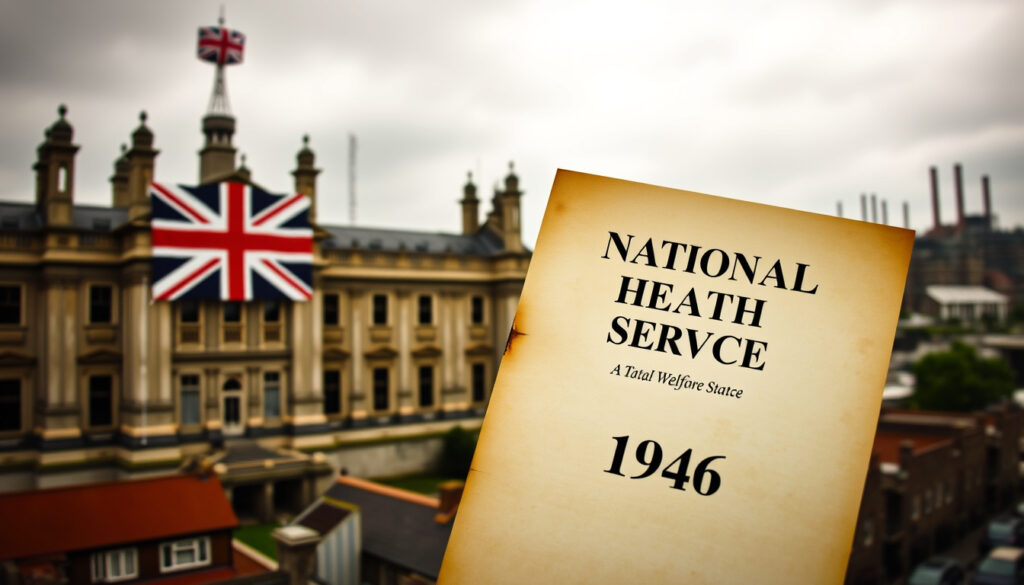
- Attlee’s government passed the National Health Service Act in 1946, and the NHS began operating on July 5, 1948 (Wikipedia). It was the first universal healthcare system funded from general taxation.
The implication: the NHS became a defining institution of British identity, free at the point of use for millions.
Nationalisation of key industries
- Attlee’s administration nationalised coal, railways, gas, electricity, and the Bank of England (Encyclopaedia Britannica). By 1951, roughly 20% of the economy was under state control.
The pattern: these were not piecemeal tweaks — they represented a deliberate shift toward a mixed economy, where the state took ownership of basic industries.
Establishment of the welfare state
- Beyond the NHS, Attlee’s government enacted the National Insurance Act 1946 and the National Assistance Act 1948, creating a comprehensive social safety net (Wikipedia). The New Towns Act 1946 and the creation of the National Parks system also aimed to improve living conditions.
Why this matters: together these policies formed the post-war consensus — a bipartisan agreement that lasted for three decades and kept Britain’s poverty rate far lower than before the war.
What was Clement Attlee’s famous quote?
Quotes on democracy and leadership
- In a 1945 radio broadcast after the election, Attlee said: “The British people have set an example to the world” (ITN interview via YouTube). Another quote often attributed to him: “A man’s got to know his limitations.”
Quotes on the British character
- Attlee once remarked, “Democracy is not a form of government; it is a way of life.” The full context is debated, but it captures his belief in collective responsibility.
The catch: the exact wording of some Attlee quotes varies across secondary sources, so careful sourcing is needed.
What was the relationship between Churchill and Attlee?
Cooperation in wartime coalition
- From 1940 to 1945, Attlee served as Deputy Prime Minister in the coalition government led by Winston Churchill (Wikipedia). They worked side‑by‑side in the War Cabinet.
Political rivalry and mutual respect
- After the 1945 election, Churchill gracefully accepted defeat, complaining that Attlee’s party had stolen his economic clothes. Despite fierce debates over nationalisation, the two remained personally cordial (Encyclopaedia Britannica).
Churchill’s remarks about Attlee
“He is a modest man with much to be modest about.”
— Winston Churchill, often repeated
- Churchill also said that Attlee was “a very able man” and that his government had “done great things.” The relationship was a combination of rivalry and professional respect (Oxford University Press blog).
The trade-off: while Churchill commanded the war, Attlee won the peace — and his domestic reforms outlasted any wartime coalition.
How did Clement Attlee die?
Cause of death
- Attlee died of pneumonia on October 8, 1967, at the age of 84 (Encyclopaedia Britannica).
Date and location
- He died in London, at his home in Westminster (Wikipedia). A state funeral was held, and his ashes were buried in Westminster Abbey.
Who was Britain’s greatest Prime Minister?
Attlee’s legacy compared to Churchill and others
- Encyclopaedia Britannica describes Attlee as “perhaps the leading Labour politician of the 20th century.” In academic rankings, he often places in the top ten British prime ministers — and sometimes ranks ahead of Churchill for domestic reform.
Historical rankings and surveys
- Several polls of historians place Attlee in the top five, citing his creation of the NHS and welfare state as transformational (Wikipedia). His quiet style and radical outcomes make him a unique figure.
The pattern: while Churchill wins on global crisis, Attlee wins on domestic legacy. For the question “Who was Britain’s greatest prime minister?”, the answer depends on the yardstick — crisis management or long‑term social change.
Timeline of Clement Attlee’s Life
- 1883 — Born in Putney (Encyclopaedia Britannica)
- 1905 — Called to the Bar (Wikipedia)
- 1914–1918 — Served in WWI, rose to major (Wikipedia)
- 1922 — Elected MP for Limehouse (Wikipedia)
- 1935 — Elected Leader of Labour Party (Encyclopaedia Britannica)
- 1940–1945 — Deputy Prime Minister in coalition (Wikipedia)
- July 1945 — Labour landslide victory, becomes PM (Oxford University Press blog)
- 1946 — National Insurance Act passed (Wikipedia)
- 1948 — National Health Service begins (Wikipedia)
- 1949 — NATO established; Attlee signatory (Wikipedia)
- 1951 — Labour lost election; Attlee resigns as PM (Wikipedia)
- 1955 — Retired as Labour leader (Encyclopaedia Britannica)
- 1967 — Died of pneumonia (Encyclopaedia Britannica)
Confirmed facts
- Attlee was Prime Minister from 1945 to 1951 (Encyclopaedia Britannica)
- The NHS was created in 1948 under his government (Wikipedia)
- He died on 8 October 1967 (Encyclopaedia Britannica)
What’s unclear
- Exact wording of some Attlee quotes varies across sources (ITN interview via YouTube)
- Some historians debate whether Attlee or his ministers deserve credit for individual reforms (Wikipedia)
Quotes from Attlee and Churchill
“The British people have set an example to the world.”
— Clement Attlee, 1945 election broadcast (ITN interview via YouTube)
“He is a modest man with much to be modest about.”
— Winston Churchill, on Attlee (Oxford University Press blog)
“Democracy is not a form of government; it is a way of life.”
— Clement Attlee (attributed)
For British voters today, the choice between a Churchill and an Attlee style of leadership is not abstract: one delivers wartime bravado, the other delivers a health service and a safety net. The legacy of Attlee’s quiet radicalism is that a country that had never known universal healthcare now cannot imagine life without it. For the Labour Party, his example remains the measuring stick for progressive government. Attlee proved that a modest man could achieve immodest things — and that the welfare state, once built, endures.
Clement Attlee’s quiet but radical transformation of Britain through the welfare state and nationalisation is the foundation of modern British social democracy. For British citizens, the NHS and the safety net they rely on are his direct legacy. For historians, he is the prime minister who made Labour the natural party of government — and whose achievements outshine his more charismatic rival.
The same man who created the most beloved institution in Britain — the NHS — is also the one who nationalised 20% of the economy. Yet he is often overshadowed by Churchill’s charisma. The paradox is that Attlee’s changes were deeper and more lasting than Churchill’s wartime leadership.
Frequently asked questions
What was Clement Attlee’s education?
Attlee studied at Haileybury College and then University College, Oxford, where he read law and was called to the Bar in 1905 (Encyclopaedia Britannica).
Was Clement Attlee knighted?
No, Attlee never accepted a knighthood. He was made an earl after his retirement but declined peerages throughout his life.
Did Clement Attlee serve in World War I?
Yes, he served in the First World War, reaching the rank of major and seeing action at Gallipoli and in France (Wikipedia).
What role did Clement Attlee play in Indian independence?
As prime minister, Attlee oversaw the partition of India in 1947 and the independence of India and Pakistan. He later called this one of his greatest achievements (ITN interview via YouTube).
How is Clement Attlee related to the Labour Party’s foundation?
Attlee was not a founder (the party was formed in 1900), but he is considered the leader who turned Labour into a credible governing party.
What was Clement Attlee’s personality like?
Described as reserved, modest, and unassuming, Attlee was known for his quiet efficiency and loyalty. His lack of charisma led Churchill to joke about his modesty.
How is Clement Attlee remembered in modern Britain?
He is widely celebrated as the founder of the NHS and the modern welfare state. His reputation has grown since his death, with many historians ranking him among the greatest prime ministers.
Related reading: NHS Band 6 Salary 2026/27: Scales & Progression Guide · Department for Work and Pensions News: Latest Updates
More related posts
 Royal Challengers vs Kings – Head-to-Head Stats and Insights
 Do Not Stand at My Grave and Weep: Poem Meaning & History
 Lakers vs Mavericks Player Stats: Luka’s 33-Point Comeback
 Sri Lanka National Cricket Team: History & Achievements
 Easiest Language to Learn – FSI’s Top 10 for English Speakers
 Mar ton Recovery Contact Number: Official Phone & Advice
 Imelda May: Biography, Net Worth, Songs, Daughter, Partner & More
 Robin Williams Cause of Death: Full Story of His Final Days
