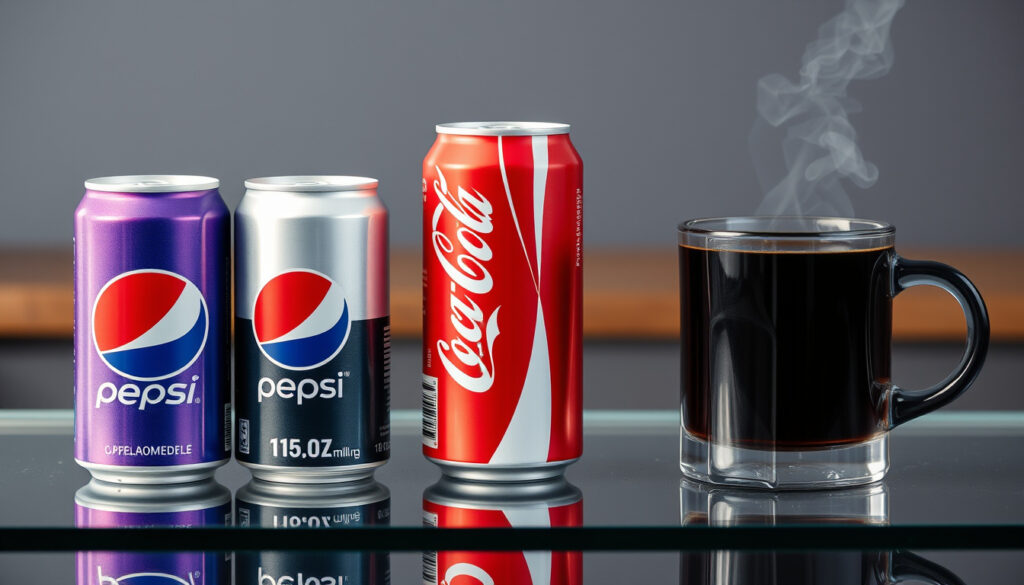
Does Pepsi Max Have Caffeine? Amounts & Comparisons
The name sounds unambiguous, but anyone scanning a can of Pepsi Max in an Irish shop will search in vain for a caffeine number on the label. Unlike a cup of coffee, which wears its caffeine content plainly on the menu, zero-sugar colas operate in murkier territory — a gap that’s widened since manufacturers began treating exact caffeine figures as commercially sensitive.
Caffeine in Pepsi Max (330ml): 42.6 mg (pre-2023 disclosure) · Caffeine per 100ml: 12.91 mg · Compared to Diet Coke (330ml): 46 mg
Quick snapshot
- Standard Pepsi Max contains caffeine (verified by ingredient listing on Pepsi Ireland)
- 42.6 mg per 330ml was disclosed up until 2023 (Caffeine Informer)
- A caffeine-free variant exists in the UK (Pepsi UK)
- Whether the 42.6 mg figure still applies to Irish cans sold post-2023
- Exact caffeine per serving for each regional formulation
- Whether formulation has changed since disclosure stopped
- 2023: Pepsi stopped disclosing exact caffeine amounts (Caffeine Informer)
- 2025: UK distributor confirmed the policy, citing commercial sensitivity (Caffeine Informer)
- Irish shoppers will continue to see only “flavourings (including caffeine)” on labels
- Caffeine-free variant offers a fully labelled alternative
| Attribute | Value / Status |
|---|---|
| Caffeine (330ml can) | 42.6 mg (per-manufacturer disclosure, up to 2023) |
| Caffeine per 100ml | 12.91 mg |
| Sugar | None |
| Calories (330ml) | Zero |
| Caffeine-Free option | Available in UK |
| Label transparency | No quantity listed on Irish/Ireland packs |
How much caffeine is in Pepsi Max?
The straightforward answer — 42.6 mg per 330ml can — comes with a significant asterisk. That figure was Pepsi’s own official disclosure, and it held until 2023, when the company moved caffeine quantities behind commercial-sensitivity reason. A 2025 query to Pepsi’s UK distributor drew a blunt response: “we are not permitted to share the exact quantities of any flavouring (including caffeine) due to the commercially sensitive nature of this information.”
Ireland’s Food Safety Authority places generic Cola/Diet Cola (330ml) at approximately 40 mg caffeine per its own guidelines — a figure that tracks closely with what Pepsi once disclosed for Max. Ireland’s labelling rules require brands to state exact mg/100ml only when caffeine exceeds 150 mg/L, which Pepsi Max does not breach. Until a brand crosses that threshold, the label can simply list “flavourings (including caffeine)” — as Pepsi’s own Irish site does.
Pepsi Max 330ml
- 42.6 mg total caffeine (manufacturer-disclosed figure, up to 2023)
- 12.91 mg per 100 ml
- 3.82 mg per fluid ounce
- No caffeine quantity shown on current Irish retail labels
Pepsi Max 500ml
No current manufacturer figure exists for the larger format. Based on the 12.91 mg/100ml rate, a 500ml can would contain roughly 64.6 mg — though consumers cannot verify this from the label. SuperValu’s Irish listing shows the same “0.4 kcal per 100ml, no caffeine quantity” as the official Irish site.
Regional variations
Regional formulation differences matter here. The US equivalent — Pepsi Zero Sugar in a 355ml (12oz) can — carries 38 mg caffeine per the Center for Science in the Public Interest’s caffeine chart, which is lower than the UK figure of 42.6 mg. Ireland’s market aligns with the UK formulation, but without current lab verification, the exact 42.6 mg figure cannot be confirmed for cans sold today. Caffeine Informer’s methodology notes it lists figures for the entire container where available from manufacturer disclosures — which no longer exist for Pepsi Max.
Which has more caffeine, Coke Zero or Pepsi Max?
Direct head-to-head data is complicated by the same disclosure gap. The US comparison is clearest: CSPI’s caffeine chart lists Coca-Cola Zero Sugar at 34 mg per 355ml, versus Pepsi Zero Sugar at 38 mg per 355ml — a modest edge for Pepsi. Taste of Home’s taste comparison notes the drinks differ in character: “if you want a cola that’s smoother and closer to its full-sugar version, Coke Zero is what you’re looking for,” while Pepsi Zero tends toward a more citrusy, spicier profile.
Coke Zero vs Pepsi Max
For the UK/Ireland market specifically, the closest verified comparator is ViDrate’s UK cola caffeine data, which lists Diet Coke at 46 mg per 330ml and Coca-Cola Classic at 34 mg per 330ml. If Pepsi Max’s pre-2023 42.6 mg figure holds, it would sit between those two — higher than regular Coke but lower than Diet Coke.
Other sodas comparison
The CSPI chart also captures Pepsi diet/zero/regular at 35–38 mg per 12oz (355ml). ViDrate’s data suggests a similar range for UK equivalents. The pattern that emerges across multiple datasets: zero-sugar colas typically land between 34 mg and 46 mg per 330ml serving, with Diet Coke sitting at the higher end and regular Coca-Cola at the lower end. The FSAI notes that “caffeine content varies by brand for colas in Ireland” — a caveat that applies equally here.
Diet Coke edges out standard Pepsi Max on caffeine — 46 mg versus an estimated 42.6 mg per 330ml. If you’re tracking intake, that’s one can of Diet Coke worth noting.
Can Pepsi Max keep you awake?
Caffeine’s half-life means the stimulant doesn’t clear the body quickly. The FDA and multiple health authorities place the adult daily limit at 400 mg; Ireland’s Food Safety Authority advises a 200 mg/day ceiling for pregnancy. One 330ml can of Pepsi Max at 42.6 mg represents roughly 10–11% of that daily limit — modest in isolation, but cumulative across several cans, coffee, tea, or energy drinks, the total rises quickly.
Caffeine and sleep effects
The science on caffeine and sleep is well-established: caffeine disrupts adenosine receptor function, delaying sleep onset and fragmenting deep sleep stages. The FSAI’s own guidance flags that caffeine effects “vary by individual” and that brand-specific caffeine levels “vary by brand” for colas — meaning two seemingly similar drinks may deliver different stimulant loads. The FSAI explicitly notes: “all figures are approximate as caffeine content and portion sizes vary within and between brands.”
Timing before bed
With a half-life of roughly 5–6 hours in healthy adults, caffeine from an evening can persists well into the night. A 6pm Pepsi Max could still be delivering meaningful stimulant effect at midnight. For those sensitive to caffeine or tracking total daily intake, the lack of a visible quantity on the can makes personalised tracking harder. The caffeine-free variant, available in the UK, sidesteps this entirely.
42.6 mg in a single can won’t keep most adults awake on its own — but combined with a morning coffee and afternoon tea, cola caffeine adds a non-trivial increment to the body’s total load.
Does Pepsi Max have no caffeine?
Standard Pepsi Max does contain caffeine. The official Irish product page lists ingredients including “Flavourings (Including Caffeine)” — the same vague phrasing that appears on physical can labels. Pepsi Max Cherry, sold in Ireland, follows the same pattern.
Standard vs caffeine-free
The caffeine-free variant — marketed as Pepsi Max No Caffeine in the UK — is a genuinely separate product with zero caffeine, maintained flavour, and no sugar. Pepsi UK’s official product page confirms this. It is not simply a reformulation flag added to the standard can — it is a distinct product available in the same markets.
Ingredients list
The standard can shows: carbonated water, colours (caramel E150d, phosphoric acid INS 338), acidity regulator (sodium citrate), preservatives (potassium sorbate, sodium benzoate), sweeteners (aspartame, acesulfame K), and flavourings including caffeine. No quantity for caffeine is required to be disclosed unless the 150 mg/L threshold is crossed.
Is Pepsi Max high in caffeine?
Relative to coffee, no. A standard 8oz cup of brewed coffee contains 95–200 mg caffeine depending on beans and brewing method — roughly 2–5× the caffeine in a can of Pepsi Max. Even a single espresso typically delivers 63 mg, more than a full can of Pepsi Max. Caffeine Informer notes: “the name Max is meant to indicate Maximum Taste — not the amount of caffeine.”
Vs coffee and tea
Coffee dwarfs cola caffeine content by volume. A typical filter coffee (250ml) delivers 100–140 mg; a strong espresso-based drink can reach 200+ mg. Tea sits at the lower end: black tea delivers 40–70 mg per cup, green tea 20–50 mg. Pepsi Max at 42.6 mg is roughly comparable to a strong cup of black tea, or a double shot of espresso in the opposite direction — notably lower.
Vs other drinks
Compared to other canned drinks, Pepsi Max sits squarely in the mid-range of caffeinated beverages. Energy drinks regularly exceed 80 mg per 250ml; some contain 160 mg or more. The FSAI places the generic zero-caffeine cola at 0 mg per 300ml — the explicit alternative for those avoiding caffeine entirely. Within the diet-cola category, Pepsi Max’s caffeine level is unremarkable: similar to Coke Zero, lower than Diet Coke.
Five cola brands, three caffeine datasets, one consistent finding: the range sits between 34 mg and 46 mg per 330ml. Pepsi Max falls within that band — lower than most energy drinks, comparable to strong tea, well below coffee.
| Brand / Format | Caffeine (mg) | Source |
|---|---|---|
| Pepsi Max UK (330ml) | 42.6 | Caffeine Informer |
| Diet Coke UK (330ml) | 46 | ViDrate |
| Coca-Cola Classic (330ml) | 34 | ViDrate |
| Cola/Diet Cola Ireland (330ml) | 40 | Food Safety Authority of Ireland |
| Pepsi Zero Sugar US (355ml) | 38 | Caffeine Informer |
| Coca-Cola Zero Sugar US (355ml) | 34 | Center for Science in the Public Interest |
| Generic zero-caffeine cola Ireland (300ml) | 0 | Food Safety Authority of Ireland |
The comparison table reveals a tight clustering of zero-sugar cola caffeine across markets — all variants fall within a 12 mg range regardless of brand or region.
| Specification | Value | Source / Status |
|---|---|---|
| Caffeine per 330ml can | 42.6 mg | Manufacturer-disclosed, up to 2023 |
| Caffeine per 100ml | 12.91 mg | Derived from above |
| Caffeine per 500ml | ~64.6 mg (estimated) | Proportional estimate |
| Caffeine per 355ml (US equivalent) | 38 mg | Caffeine Informer |
| Current Irish label disclosure | None (quantity) | “Flavourings (Including Caffeine)” only |
| Ireland caffeine labelling threshold | 150 mg/L | Food Safety Authority of Ireland |
| Pepsi Max Caffeine-Free | 0 mg | Pepsi UK |
| Adult daily caffeine limit | 400 mg | FDA / health authorities |
| Pregnancy daily limit (Ireland) | 200 mg | Food Safety Authority of Ireland |
The spec table gives a full picture of what is known, what is estimated, and what remains undisclosed for Irish consumers.
What we know and what we don’t
Confirmed
- Standard Pepsi Max contains caffeine (ingredient label, Irish and UK)
- Manufacturer disclosed 42.6 mg per 330ml up to 2023
- Pepsi has stopped disclosing exact figures since 2023
- UK distributor confirmed refusal to share figures in 2025
- Caffeine-Free variant exists and is genuinely caffeine-free
- Ireland’s labelling threshold is 150 mg/L
Unclear
- Whether 42.6 mg still matches current Irish can formulation
- Whether formulation has changed since 2023
- No current lab-tested figure for Pepsi Max Ireland post-2023
- Whether UK/Ireland cans match Canadian formulation (69 mg/355ml)
- Exact caffeine per specific serving size formats
Food Safety Authority of Ireland
“All figures are approximate as caffeine content and portion sizes vary within and between brands.”
Pepsi distributor UK (2025)
“Unfortunately we are not permitted to share the exact quantities of any flavouring (including caffeine) due to the commercially sensitive nature of this information.”
Pepsi Max sits in a strange middle ground: caffeinated enough to matter for anyone tracking intake, but vague enough on the label that most consumers have no idea how much they’re drinking. The 42.6 mg figure from pre-2023 disclosures is the best anchor available, but it cannot be treated as confirmed current data. Ireland’s food safety authority has published 40 mg as a generic cola average for 330ml — close enough to suggest the figure hasn’t shifted dramatically, but not a guarantee.
For Irish consumers, the practical path forward is straightforward: if exact caffeine tracking matters, the caffeine-free variant removes the guesswork entirely. If the standard can is preferred, treat it as carrying roughly 40–43 mg per 330ml — in line with other diet colas, well below coffee, and additive to the day’s total. The ambiguity is real, but the options are clear.
Related reading: How Many Calories in an Avocado · What Is Keto Diet
Pepsi Max maintains steady caffeine levels globally, with official Swedish Pepsi Max data confirming around 43mg per 330ml can from Carlsberg Sweden.
Frequently asked questions
Does Pepsi Max have sugar?
No. Pepsi Max is a zero-sugar cola. It uses aspartame and acesulfame K as sweeteners and contains no sucrose or glucose.
Does Pepsi Max have calories?
No. Pepsi Max shows 0.4 kcal per 100ml on Irish labels — effectively zero calories per serving. It is classified as a zero-calorie product.
What is in Pepsi Max ingredients?
Carbonated water, colours, acidity regulator, preservatives, sweeteners (aspartame, acesulfame K), and flavourings including caffeine. No caffeine quantity is disclosed.
Pepsi Max caffeine vs coffee?
A 330ml can of Pepsi Max contains roughly 42.6 mg caffeine, compared to 100–200 mg in a standard 250ml brewed coffee.
Is there Pepsi Max without caffeine?
Yes. Pepsi Max No Caffeine is sold in the UK, offering the same flavour with zero caffeine.
How long does Pepsi Max caffeine last?
Caffeine has a half-life of roughly 5–6 hours in healthy adults. A can consumed at 6pm could still deliver noticeable stimulant effect near midnight. Individual sensitivity varies.
Is Pepsi Max safe for daily use?
For most healthy adults, one can per day (roughly 42.6 mg caffeine) falls well within the 400 mg daily limit. Pregnant individuals should follow the FSAI’s 200 mg/day guidance.
More related posts
 Minimum Wage 2026 UK: Rates, Annual Salary & What to Expect
 Cast of Ghostbusters: Frozen Empire — Who’s In, Who’s Out
 Lakers vs Mavericks Player Stats: Luka’s 33-Point Comeback
 Maslow Hierarchy of Needs: 5 Levels and Anxiety
 Did the clocks go back? UK autumn clock change 2025 explained
 Pie in the Sky: The Idiom and the BBC Detective Series
 The Secrets She Keeps: Plot, True Story, Cast & Where to Watch
 Jason Manford: Children, Weight Loss & Marriage Split
